Stories
|
Crafting the Style of Cursed
May 04, 2026
Written by Leif Pedersen
Created by an inspired team of nine students at ESMA (École Supérieure des Métiers Artistiques), Cursed is a heartfelt exploration of a mother's desperate attempt to protect her child from a dark fate. Bringing this fairy tale to life took a year and a half of intense collaboration, technical trickery, and a unified vision. The result is a short film that beautifully blurs the line between modern 3D rendering and classic 2D illustration.
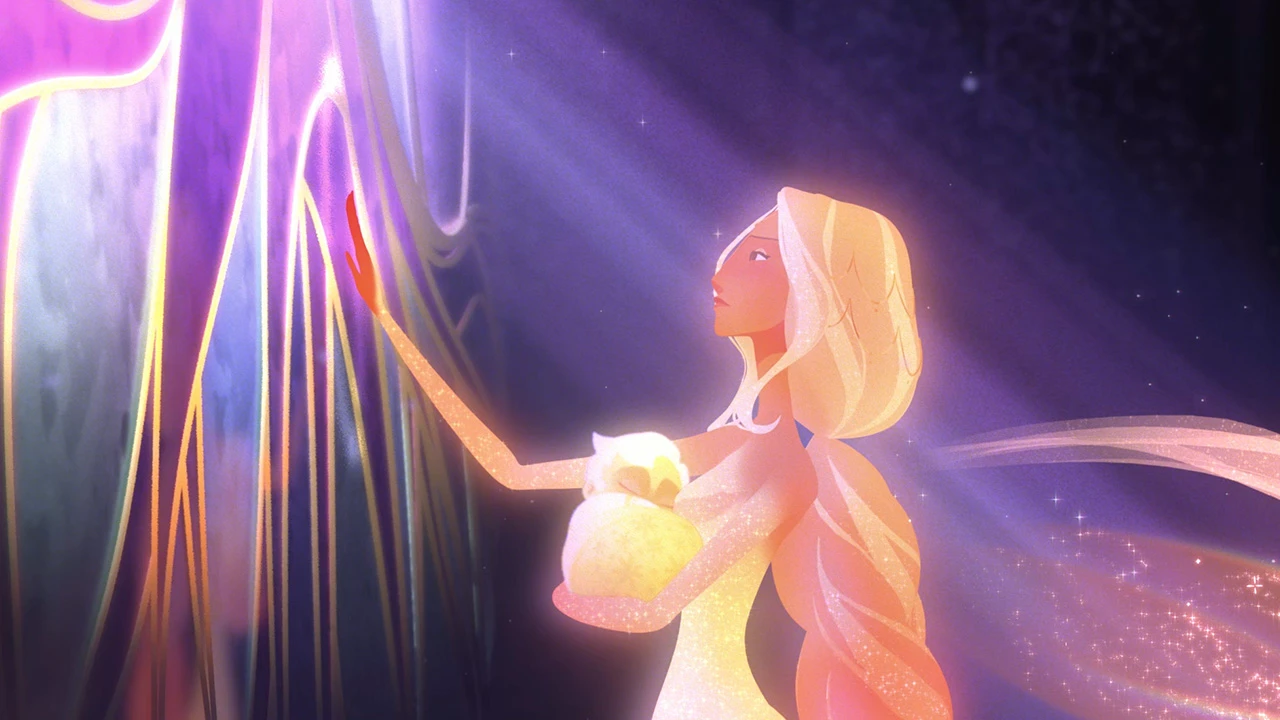
The protagonists of Cursed
The original concept was based on the Greek mythology of Hades and Persephone and reimagined by Margaux Deculty, Compositing and Lead Concept Artist on Cursed. “It was a team effort to really come up with a polished concept we could build on,” said Margaux.
“We all grew up with Disney fairy tales and fantasy, so when we came together creatively, we asked ourselves ‘Why don't we do a fairy tale … but with a twist’ while maintaining a 2D, almost nostalgic aesthetic,” said Ashe Daniel, LookDev and Lead Character Artist on Cursed.
“We wanted something that stood out and gave audiences a sense of nostalgia, so we did a lot of research and development to iterate on the final look,” said Alisson Pigerol, Lookdev, Compositing and Lead Texture artist on Cursed. “We got pretty close to the in-render and we added nice glows and effects in post.”
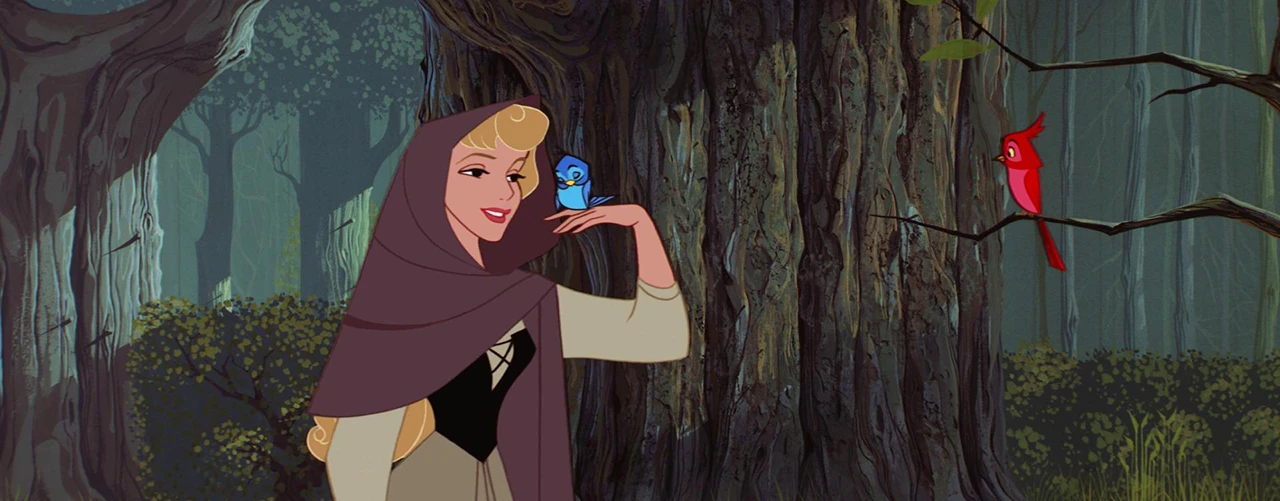
Disney’s Sleeping Beauty (1959) was one of the aesthetic inspirations for Cursed.
Achieving a flat, illustrative look in a 3D pipeline required the team to constantly push back against the natural inclinations of physically based rendering (PBR). “We were trying to fight the 3D so we could deconstruct it for a 2D look,” explained Ashe. “We ended up manipulating shadows and lights in certain places. To have control over what was affected by the lights in the scene. Our goal was a flat base that mimicked an illustration, so that we could build complexity on top of that afterwards. For example, we baked any shadows on the faces and bodies of the characters, but they would cast no shadows on the environment in render,” she continued.
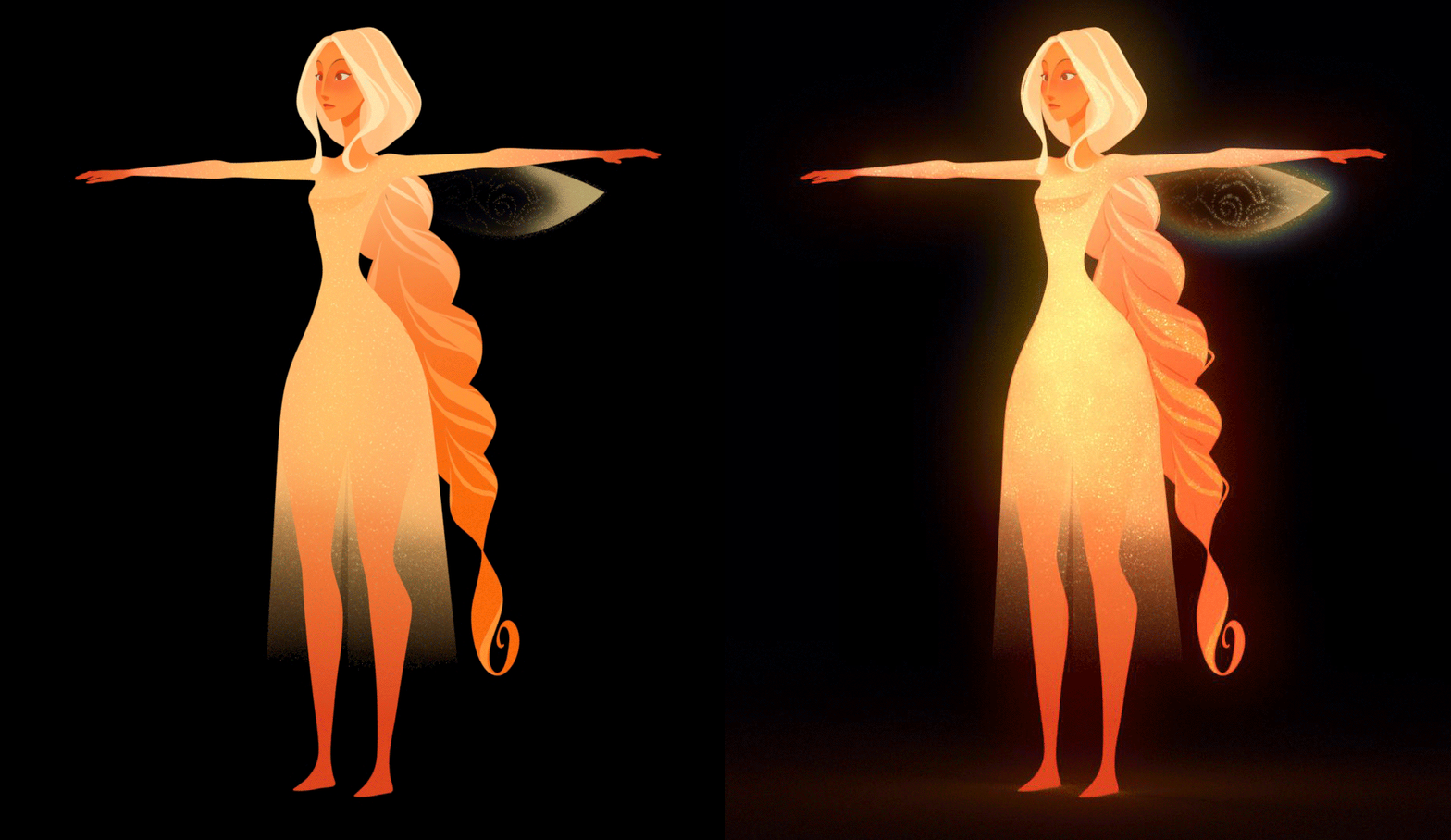
Lookdev renders before and after compositing
The environments posed a specific challenge for this aesthetic. “Like any good forest, the main challenge for the environment were the trees,” said Andrea Mamessier Degrange, Lightning and Lead Rendering artist on Cursed. “To make a tree look 2D we painted the normals of the trunks and the leaves to make them as flat as possible ... and to further direct the normals of the shadows for that painterly bark effect.”
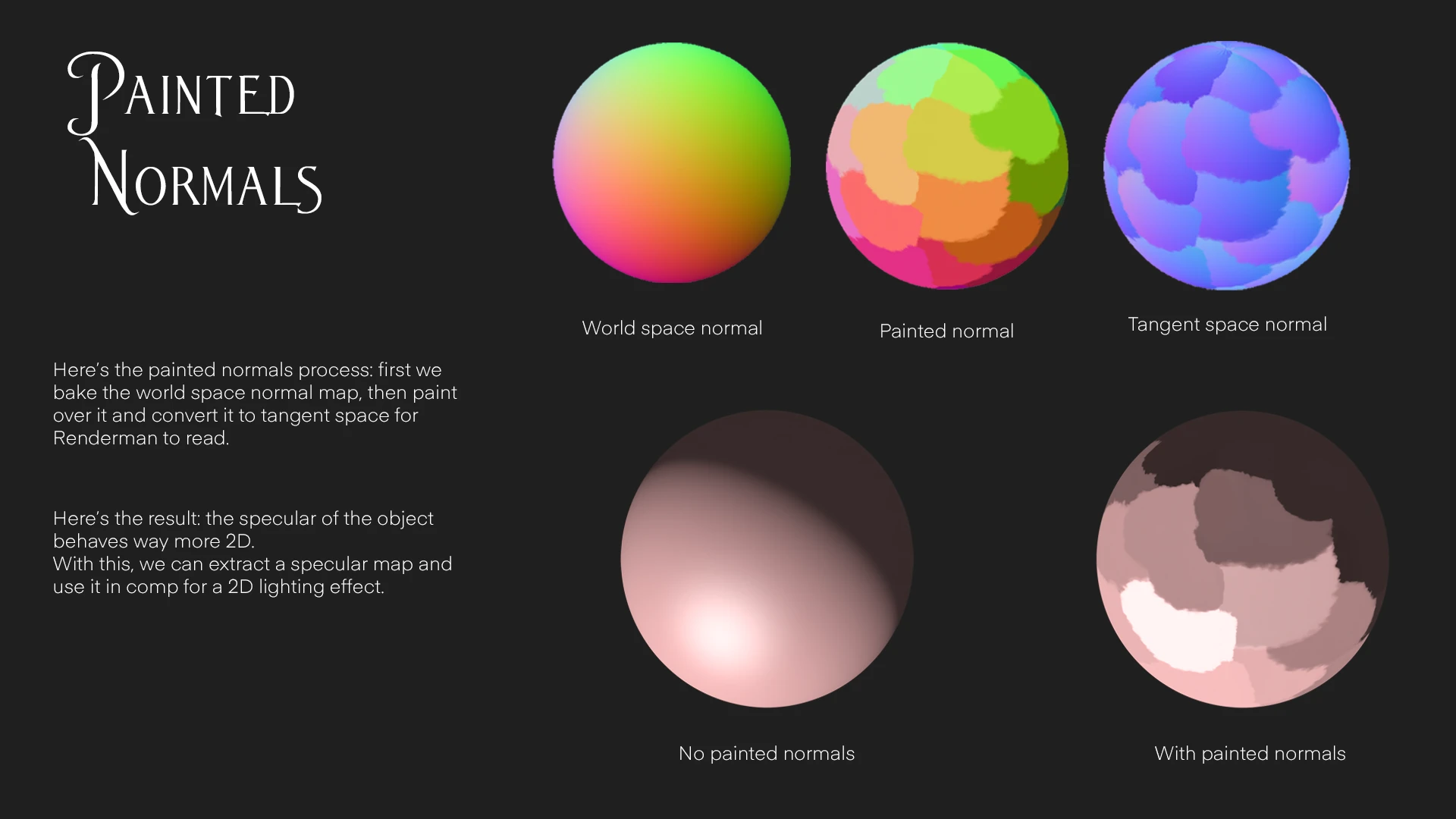
Visual explanation of the painted normal workflow
Using the team’s background in concept art, they also got creative with the look development for the leaves in Maya. “We mapped individual pixels per-leaf instance, giving us a nice and flat look,” said Ashe. This helped the team get lightweight assets and modules that would react like illustrations, which they would populate entire forests with.
Film Reel for Cursed
Because the characters were glowing, magical beings, relying on standard scene illumination wasn't an option. The team kept the RenderMan lighting incredibly simple. “We often used distant lights to react with custom tree normals for some shaping of the foliage, but we heavily relied on post-production and RenderMan AOVs and LPEs for a lot of the final look,” said Andrea Mamessier.
“The beauty pass (jargon for a final render) included a shadow pass which we heavily used in compositing,” said Margaux Deculty. “We limited the lighting in the scene so that we could rebuild the lighting using AOVs and LPEs in compositing. This gave us the ability to really customize the look and make sure the glowing characters could interact properly with everything in the set,” added Ashe Daniel.
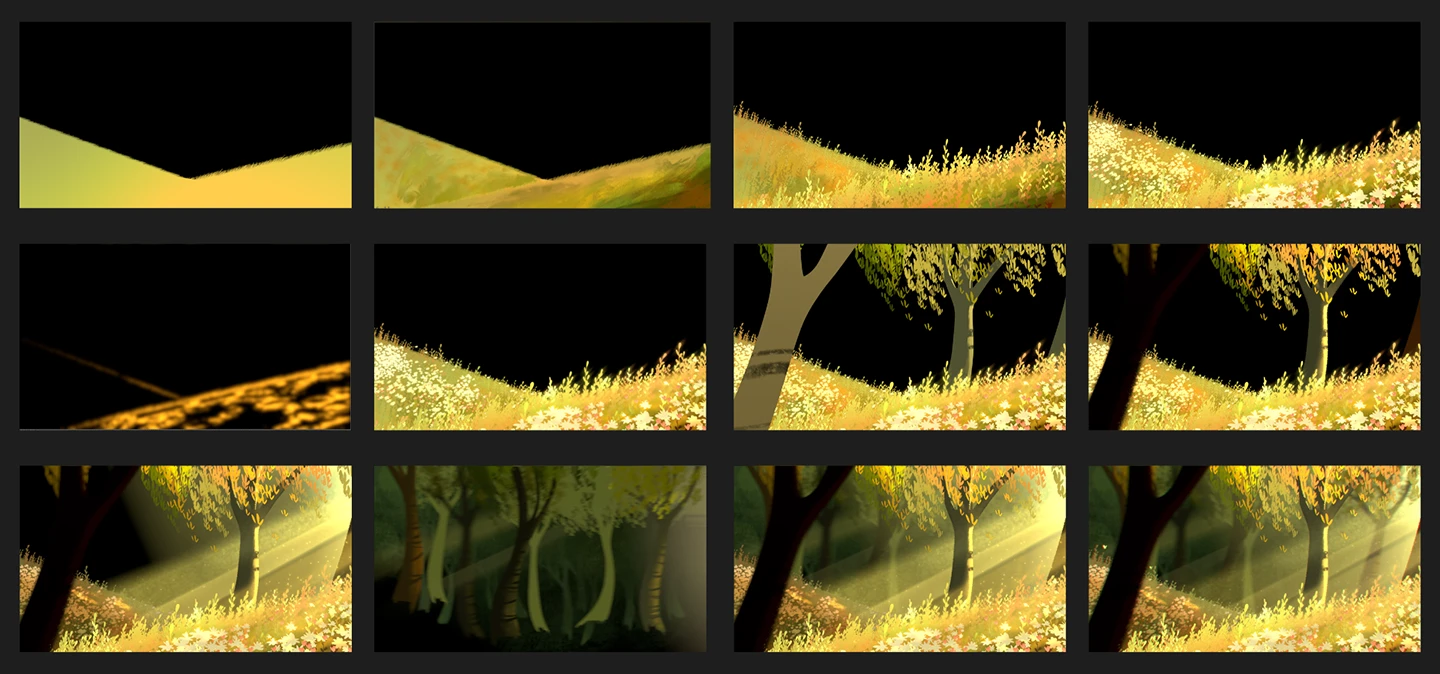
RenderMan outputs were used to blend scene elements seamlessly in post.
The compositing team used these flat renders as a canvas, leveraging Nuke to dial in diffuse ambient light, specular highlights, and the glowing halos around the characters. To further ground the vintage aesthetic and hide any lingering 3D artifacts, the team applied a heavy layer of film grain over the final images. Each shot was built up in layers like a painting to maintain that nostalgic hand-painted feeling.
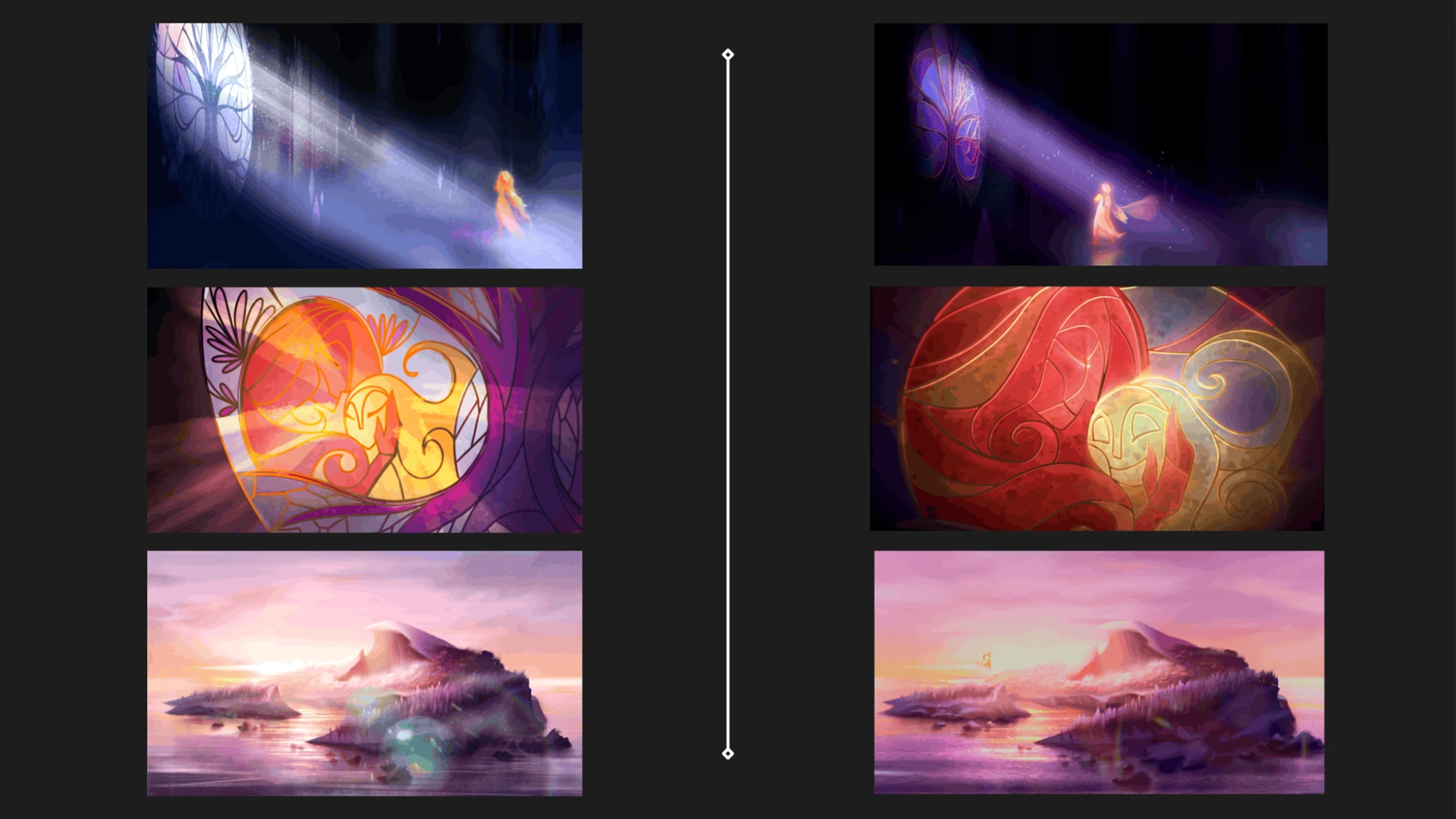
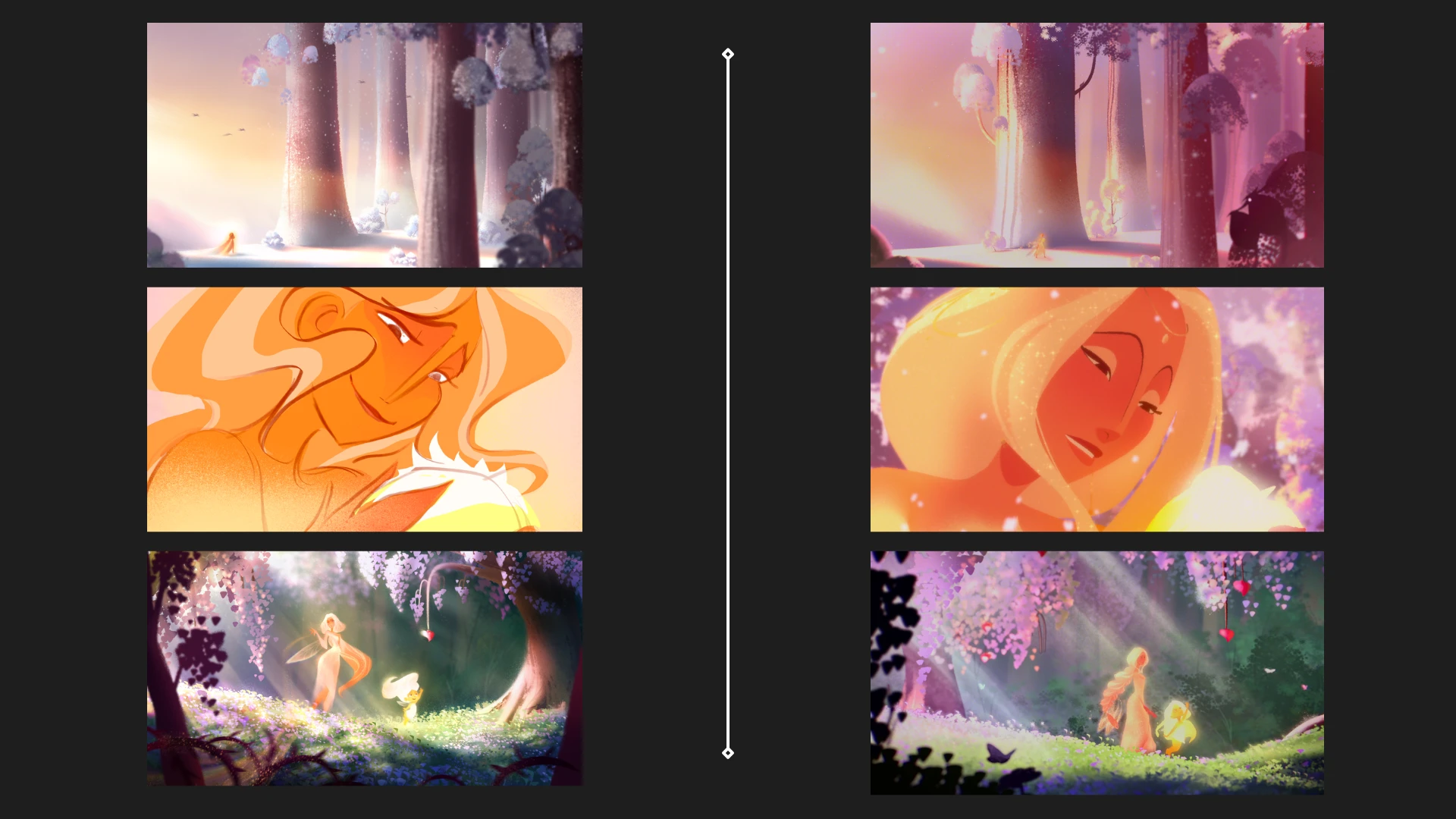
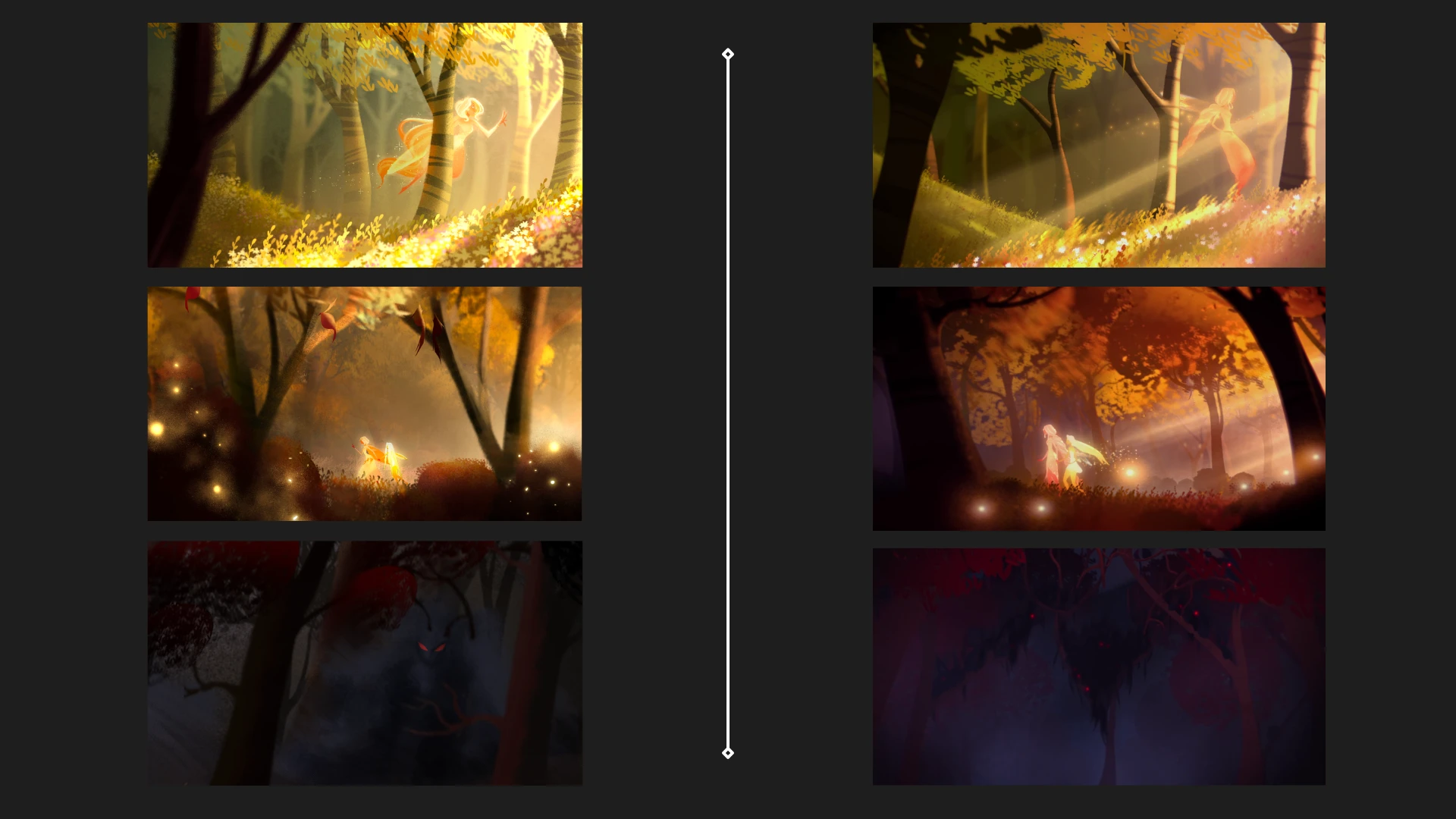
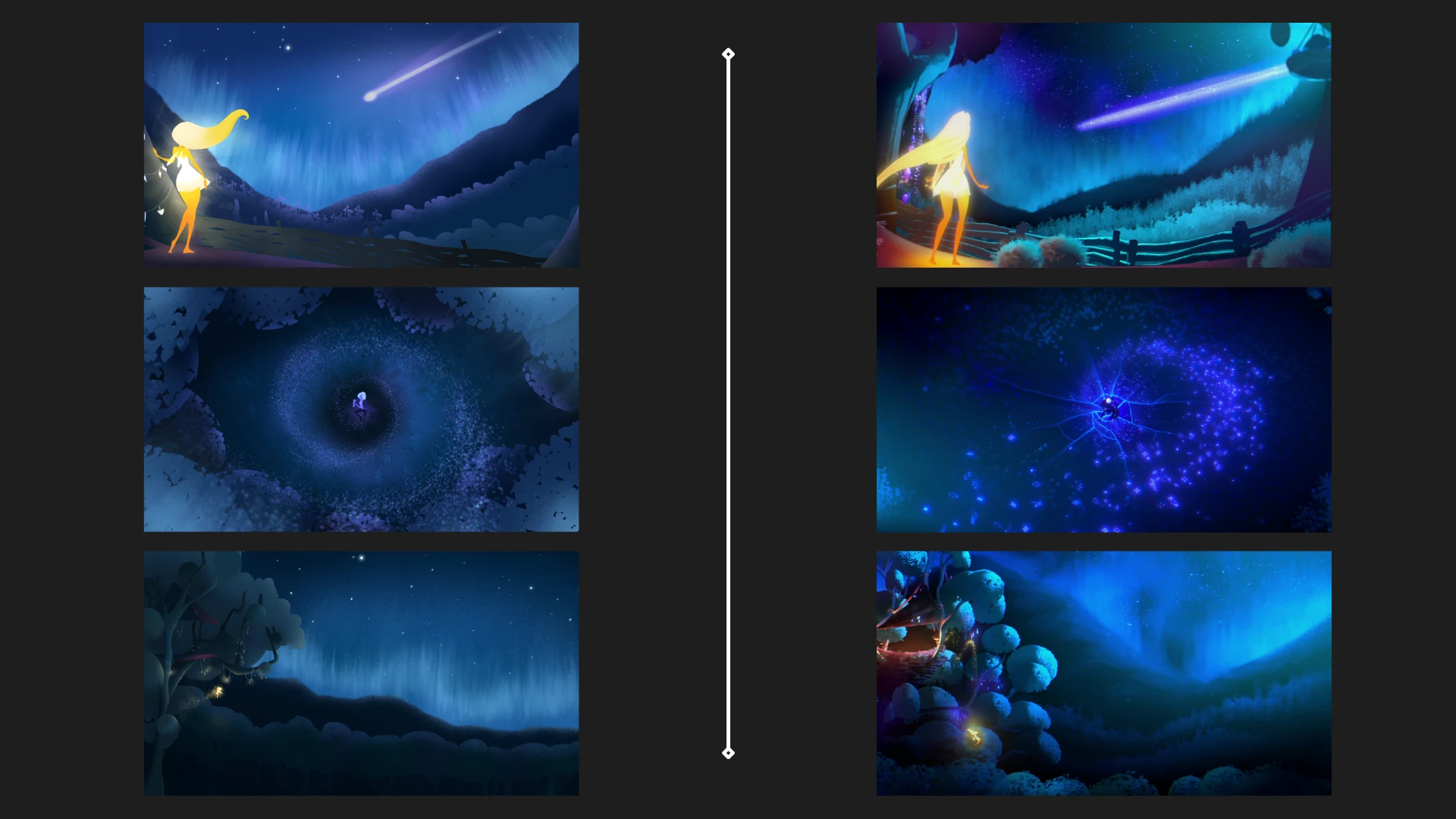
2D concepts and their translation to 3D output.
To bridge the gap between 3D character movement and the illustrated environments, the team had to think out of the box to force the tools to do what the outcome required. ”At first, we tried to treat the scene like an abstract painting, scattering flowers and plants randomly and adding them on top of the rest in comp. It was breaking the natural parallax effect of 3D, and didn’t translate very well when the camera was moving. We had to think less of the concept and more of the 3D, to find a good balance,” said Alisson Pigerol, LookDev, Compositing and Lead Texturing Artist. The foreground, middle and background were all rendered in separate layers to be combined like the traditional hand-drawn animation process before computers.
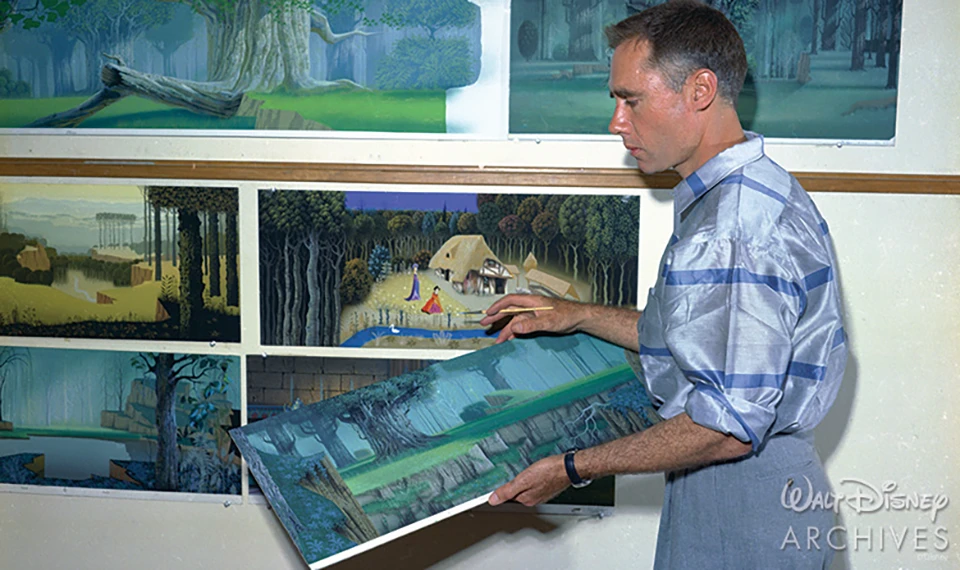
Disney artist Eyvind Earle’s illustrations and process were an immense source of inspiration for the team.
To bring the fantasy elements of the film to life, the team's VFX and concept artists jumped in. “We made sparkles, magical trails, and ambient effects in Procreate and then mapped them onto flat 3D planes. The others were complex VFX simulations which were drawn over or had custom shaders,” said Myriam Brandao Serseri, Lead Visual Effects artist on Cursed.
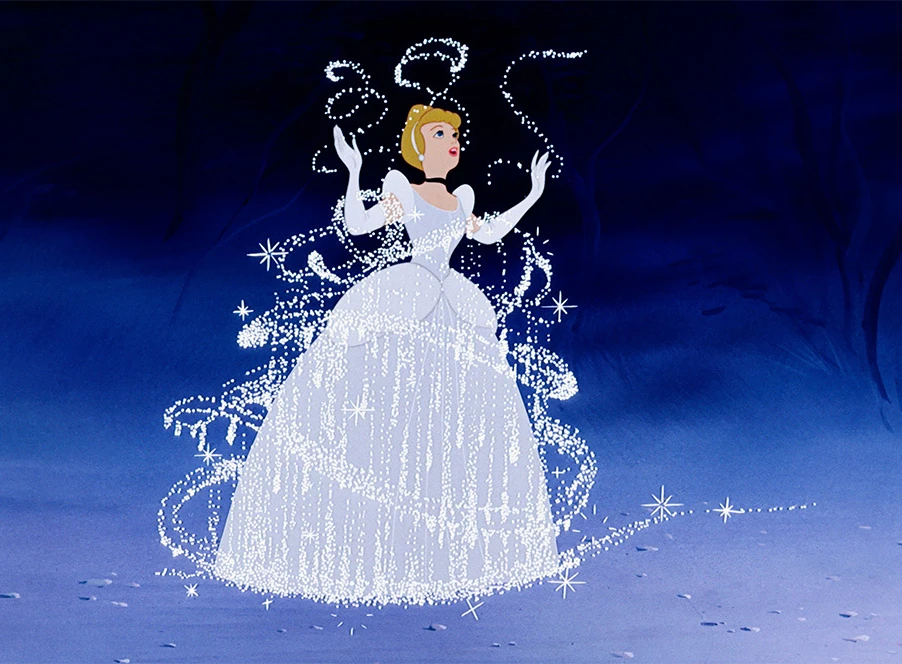
Disney’s Cinderella (1950) iconic transformation inspired the glitter in Cursed.
For the characters' sparkling wings and body glitters, the team exported UV maps, mixed painted glitter effects with the PxrFlakes node (developed initially for car shaders) then exported as RGB masks with the PxrTee node, and mapped them back onto the models in Nuke to complete the look (they would react to the light in early tests.)
Effects Reel for Cursed
The animation process presented its own unique set of challenges. To mimic the cadence of classic hand-drawn animation, the team animated the characters "on twos" (12 frames per second). However, to keep the cinematography feeling dynamic, the camera moved at a smooth 24 frames per second. “It was a challenge to minimize sliding and strobing effects,” Alisson noted. “In the forest running sequence, the camera moves at 24 FPS, but the characters stay at 12 FPS, so there was this kind of sliding on the ground, not only affecting the performances, but also the parallax. There were some struggles, but we overcame them thanks to our compositing team, led by Marie Seve.”
Layout Reel for Cursed
Beyond technical hurdles, the emotional weight of the story required specific acting references. To get the timing of the important emotional moments, the animators became the actors. “We took a lot of acting references ourselves. It was important so that we could understand the emotions of the characters,” said Nicolas Paoli, Animator and Production Manager on Cursed. “We ended up knowing every line by heart. Every time someone new was watching the movie, we were in the back just mimicking the whole dialogue. It was really fun,” he laughed.
Animation Reel for Cursed
“We put a lot of care into facial expressions and emotions. Getting the silhouette of the characters right was very important to communicate the subtlety of the story, especially given the flatness of the look,” said Marion Boitelle, Animation and Rigging artist on Cursed.
The sheer ingenuity with which Cursed came together is a testament to the team's dedication and problem-solving skills. By communicating constantly across departments and using their tools in unconventional ways, they successfully crafted the 3D to deliver a beautiful 2D film full of magic.
Cursed has been picked up by a distributor, Yummy films, and is currently on its festival run as of Spring 2026. You can follow the team's journey at festivals and see more behind-the-scenes content on their Instagram @cursed.shortfilm.


